
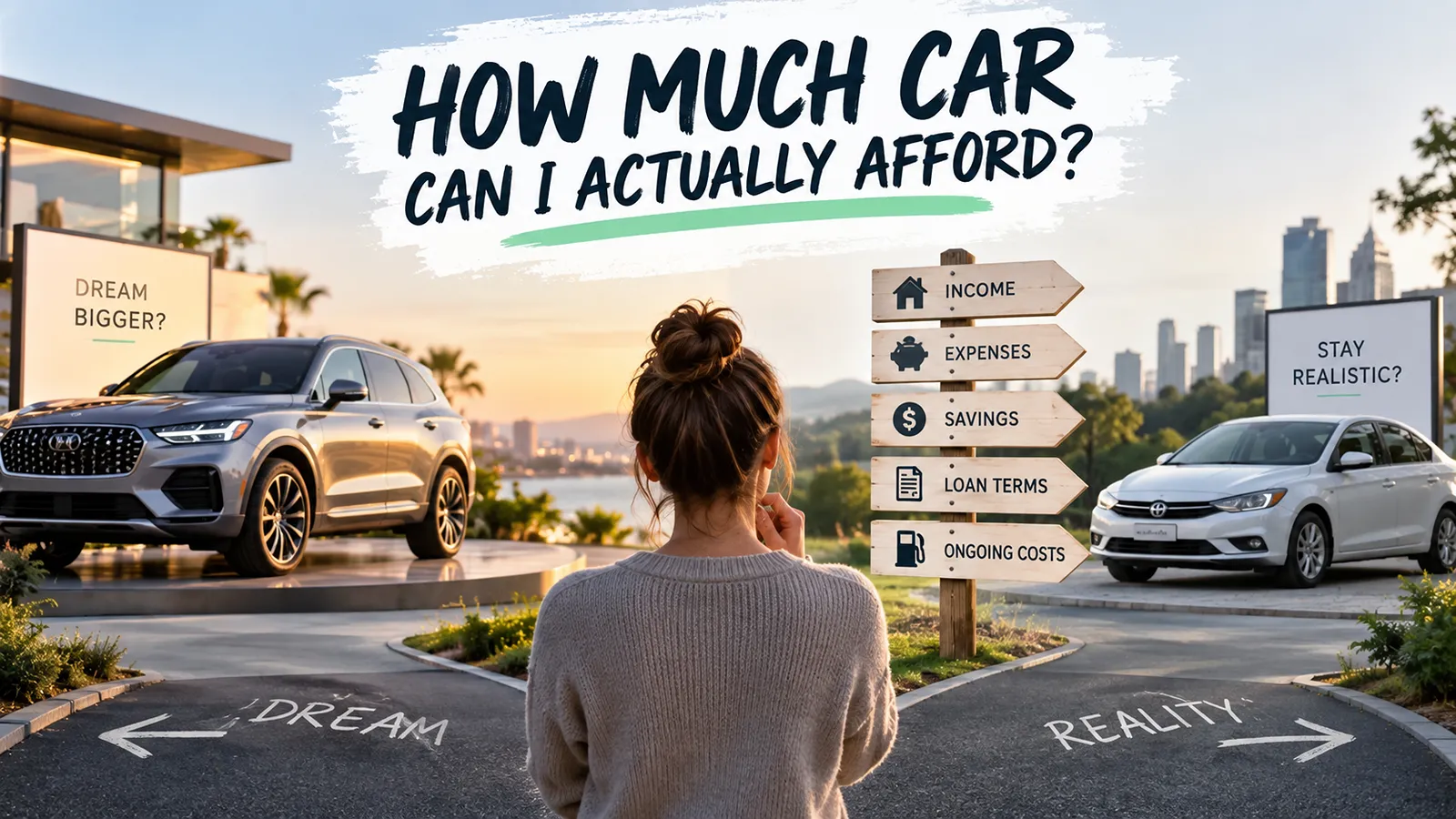
How Much Car Can I Actually Afford?
TL;DR
- A widely used guideline is 20/4/10: put 20% down, finance for no more than 4 years, and keep your total car costs under 10% of gross monthly income.
- Lenders will approve you for considerably more than that. Approved and affordable are not the same number.
- Your real budget is the payment plus insurance, fuel, maintenance, and registration.
- Stretching the loan term lowers the monthly payment and raises what the car costs you in total.
Most people can comfortably afford a car when the payment, insurance, fuel, and upkeep together stay under roughly 10% of gross monthly income, with about 20% down and a loan no longer than four or five years. On a $6,000 monthly income that's about $600 a month all in, which usually lands you in a car in the high teens rather than the thirties.
That number is almost always smaller than what a lender will hand you. The gap between the two is where most people get into trouble, so it's worth understanding both.
What is the 20/4/10 rule?
It's a rule of thumb, not a law, but it holds up well:
- 20% down. A real down payment keeps you from owing more than the car is worth the moment you drive it.
- 4-year loan. Four years is the outer edge of comfortable. Five is defensible on a newer car. Six or seven is a warning sign.
- 10% of gross income for everything the car costs you, not just the loan payment.
If you fail one leg of the rule, that's a signal, not a verdict. If you fail all three, the car is too expensive.
How much will a lender actually approve?
Considerably more, and this surprises people. Auto lenders mostly look at two ratios:
- Payment-to-income (PTI) — your car payment as a share of gross monthly income. Many lenders are comfortable up to about 15%, and some go higher.
- Debt-to-income (DTI) — all your monthly debt payments, including the new car, against gross income. Lenders commonly want this under about 45%.
On that $6,000 income, a 15% PTI means a lender might approve a $900 monthly payment. The 10% all-in guideline leaves roughly $300 for the loan payment once insurance, fuel, and upkeep are covered, as the next section works through. That's close to a three-to-one gap between what you can borrow and what comfortably fits.
The lender isn't being reckless. It's underwriting the odds that you keep paying, not the question of whether the car leaves you room to save, absorb a repair, or change jobs. That second question is yours.
What does this look like in real numbers?
Take that $6,000 gross monthly income and a $600 all-in car budget. Insurance runs about $150 a month, and fuel plus maintenance another $150. That leaves roughly $300 a month for the loan payment.
At a 9% APR, used here purely as an illustration — your own rate depends on your credit, the car, and the lender:
- Over 48 months, $300 a month finances about $12,050, and you pay roughly $2,350 in interest.
- Over 60 months, the same $300 finances about $14,450, and you pay roughly $3,550 in interest.
The extra year buys you about $2,400 more car and costs about $1,200 more to borrow. Add a 20% down payment to the 60-month version and you're shopping around $18,000 with roughly $3,600 down. That's the honest answer for that income, and it's a long way from the $40,000-plus that a $900 approved payment would stretch to over the same term.
Run the same math on your own income before you start looking. It changes what you click on.
What does a longer loan term really do?
It lowers the payment and nothing else. Every month you add spreads the same debt thinner, so you pay more interest and you stay underwater longer, meaning you owe more than the car is worth.
That matters most if something changes. If you need to sell or trade in year three of a 72-month loan, the gap between the payoff and the car's value comes out of your pocket or rolls into the next loan. Our guide to trading in a car that still has a loan walks through how that plays out.
A shorter term with a slightly cheaper car almost always beats a longer term on the car you'd rather have.
What costs besides the payment?
In the example above, the loan payment is only half of what the car costs each month. The other half:
- Insurance, which varies enormously by car, driver, and state. Get a quote on the specific vehicle before you buy, not after.
- Fuel, based on your real commute rather than the window sticker's estimate.
- Maintenance and tires, which are cheap for a while and then aren't. Budget for it monthly even though you'll spend it in lumps.
- Registration and taxes, which depend on your state and are often due up front.
- Doc fees and other dealer charges, which vary by dealer. Ask what they are before you agree to a price.
A $400 payment on a car that's expensive to insure and thirsty on fuel can cost more per month than a $500 payment on one that isn't.
How do I find my number before I shop?
- Check your credit first. It sets your rate, and your rate sets how much car a given payment buys. See what credit score you need to buy a car for the tiers lenders use.
- Get pre-qualified. A pre-qualification that uses a soft credit check gives you real numbers without affecting your score.
- Count your trade-in and your cash together. Equity in your current car counts toward the 20% down.
- Shop by total price, not by payment. Any payment can be reached by stretching the term. The price and the rate are what you're actually negotiating.
On Keysy you build the deal yourself: pick the car, add your trade-in, set your down payment and term, and see the payment before you commit to anything. If a number doesn't work, change it and watch what moves. That's the same math above, just faster than a spreadsheet.
Frequently asked questions
Does a bigger down payment lower my interest rate? Sometimes. It always lowers the amount you finance, and lenders occasionally offer a better rate at a lower loan-to-value. The guaranteed benefit is that you borrow less.
Should I use the payment a lender approved me for? Treat it as a ceiling, not a target. Approval measures the lender's risk, not your budget.
Is a 72-month car loan ever a good idea? Rarely on a used car. If only a 72-month term makes the payment work, the car is above your budget.
Does checking what I can afford hurt my credit? No. Checking your own credit is a soft inquiry, and so are most pre-qualification tools.
Work out your all-in number first, then shop inside it. It's much easier than falling for a car and reverse-engineering a way to justify it. If you want to see how the whole purchase works start to finish, read whether you can really buy a car 100% online.
More from Keysy Resources

Is a 72-Month Car Loan a Good Idea?
A 72-month car loan lowers your monthly payment, but you pay more interest and stay underwater longer. Here's the math on loan length and how to pick a term you can live with.
How Much Down Payment Do You Need for a Used Car?
There's no universal minimum down payment on a used car. Many buyers aim for 10% to 20% because it lowers the payment and protects against owing more than the car is worth. Here's how to choose your number.
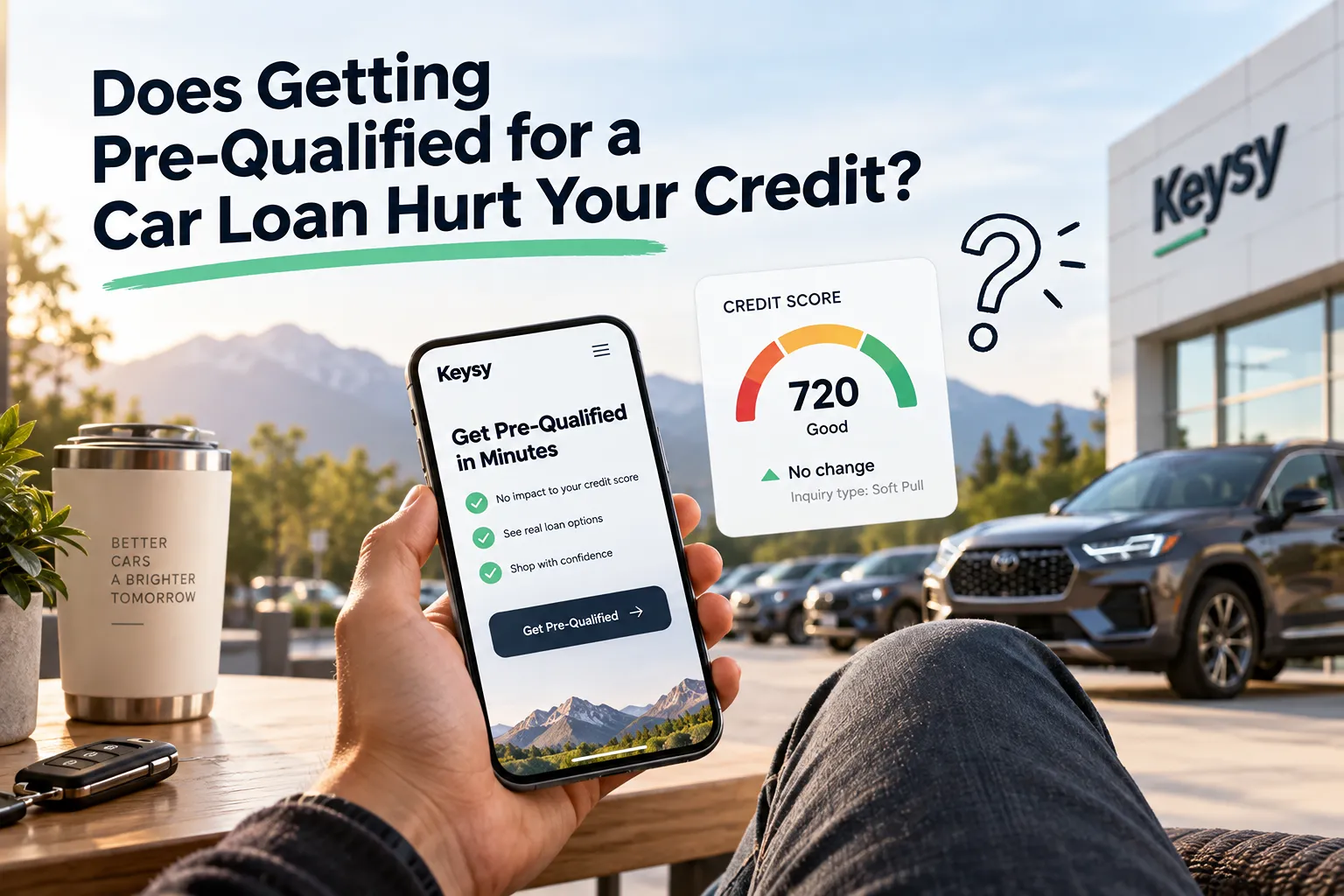
Does Getting Pre-Qualified for a Car Loan Hurt Your Credit?
Pre-qualifying for a car loan usually uses a soft credit check, which doesn't affect your score. Here's how it differs from a hard inquiry, and when a hard one happens.